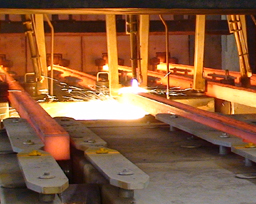
The purpose of the continuous casting is to bypass conventional ingot casting and to convert liquid steel directly into semi products in the form of billets directly roll-able on finishing mills .The use of this process results in improvement in yield, energy consumption and product quality.
Continuous casting involves the following sequence of operations
- Delivery of liquid steel to the casting strand (S).
- Formation of the cast section in water-cooled mould.
- Further heat removal from casting strands by water sprays, starting beneath the mould and continuing over the required length.
- Continuous withdrawal and straightening of the casting strands.
- Cutting and discharge of the cast product.
Molten steel in a ladle flows into a tundish above th C.C.M which serves as distributor, reservoir and as a final refiner of the liquid steel .The tundish is carried by a tundish car. The steel flows from the ladle to the tundish should be kept constant. The steel flow from tundish to mould is carried out by a calibrated nozzle .A radiometric mould level detector is built in the mould assembly. The liquid steel is cast into a water-cooled open-ended copper mould. Primary solidification begins immediately at the surface of the water-cooled copper mould, which has a sufficient length, so that the solidified shell thickness is capable of retaining the liquid steel core after the copper mould.
Characteristics of VAI-POMINI billet caster are modular design for quick exchange of components, high level automation, utilization of proven technology, high quality component, advanced machine head with DIAMOLD mold system and DYNAFLEX-hydraulic oscillator system, advanced cooling system , continuous straightening system ,rigid dummy bar system ,torch cutting system ,hydraulic turnover cooling bed.